I came to realise quite early on that it’s not ‘cheating’ to adopt the ideas, processes and tools of other successful businesses into yours. You’re not expected as an entrepreneur to innovate how you operate from scratch. It’s frankly impossible for one business, let alone one mind, to have all the answers without observing.
So, if it’s not cheating, if it’s not illegal, why wouldn’t you?
Some advice which stuck from me was provided by James Ashford, a business owner who developed pricing software for accountants and managed a hugely successful exit. He said to us accountants – “you’re not competing with other accountants, you’re competing with Amazon”.
What he meant by that, (and it applies to any business by the way, not just accountants) is that companies like Amazon, with their ease, pace and accuracy of ordering, and the range of products, have raised the bar. Because of companies like Amazon, the rise of technology, and the shift of attention spans with the likes of TikTok thriving, people expect what they had quicker, automated, better, in a reliable and cost-effective way.
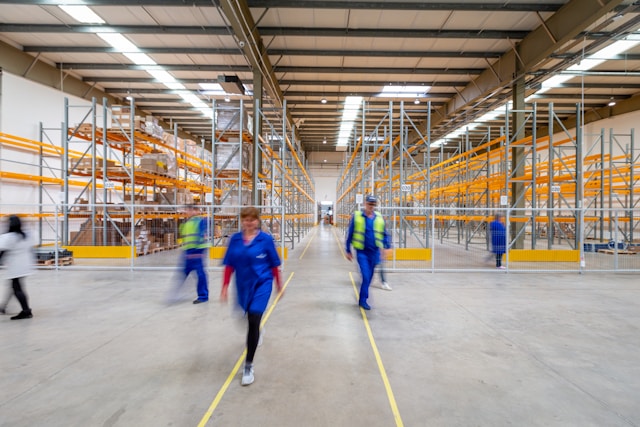
I recently had the opportunity to visit an Amazon Fulfilment Centre (“LUT4”) local to me, so with this in mind, I took a tour, and this is what I took away from a fascinating trip.
For those who are not clear on how these centers work, both small businesses and Amazon send goods to be stowed in the Centre, and are then listed for sale on Amazon. Then when they are ordered, they are picked, and dispatched out to distribution centres across the country, where they then end up in one of the hundreds of Amazon vans travelling our streets every day going to our door. Sounds simple? But an awful lot goes into it. Here are five things I learned, and will be adopting in my business.
1. Amazon really look after their staff
I have like many heard some stories about Amazon’s employment practices – monitored toilet breaks, quotas to hit, and tight turnaround times, and many associate Amazon’s drive for efficiency and speed with tough working conditions on staff.
However, the tour made a big deal of explaining to us how they do look after our staff.
Perks such as ‘game’ times, where staff can relax for 5 hours a month to do anything from watch sports to playing in tournaments with colleagues, canteens, and a HR department on the LUT4 floor, did show to me they certainly did take employee welfare very seriously.
They are even more obsessed with health and safety – even with small things such as vending machines for PPE, regularly spaced break-out zones, eye wash stations, and workstations designed to avoid repetitive strain, they could boast of an immaculate health and safety record.
But the most fascinating thing was their approach to apprenticeships. Work for Amazon for one year, and they will fund an apprenticeship for you, regardless of your role there. And even more amazing, was that they would continue to fund it even if you left Amazon.
Whilst most businesses simply cannot afford such perks, it did get me thinking – what’s your most important asset, and how are you looking after them? Amazon have tonnes of assets of all shapes and sizes, but I would hazard a guess they would say it’s their +1m global workforce.
There are probably very simple, low cost perks you can provide your team worth way more than the cost of them to you and your business.
For us at Mayflower, it’s the same too – our people – as without them, we simply can’t achieve what we have. Think about what is the main asset you have – whether it’s people, your machinery, your procedures, and think how you are nurturing that asset, and ensuring it endures and thrives in your business.
2. They made it so anyone can do the job
Towards the end of the tour, we were invited to pack an order. No extensive training, just guided by incredibly robust processes.
You scan an item, and it will tell you:
-
- What package size to use
-
- Whether you need to put a label on the box that it contains hazardous materials, or things such as batteries (which you have to scan, to make sure you don’t forget to affix it)
-
- Whether you need to include a gift message inside the box
-
- What length of tape you need to seal that package
It meant people on that tour could literally turn up and pack orders without fault.
Amazon staff are also multi-skilled, meaning the workforce can move from picking items, to packing, where demand is needed.
These processes meant two things. First, anyone could do the job. Second, it meant anyone could do the job reliably, consistently and accurately.
McDonald’s is so successful not because it produces the tastiest burgers, but because it delivers an incredibly consistent experience, wherever you are in the UK. Customers go there because they know they’ll get a meal that is going to be cooked properly, taste as they expect, and be quick to pick up.
Could you, in your business, systemise procedures you do, to make sure whenever customers deal with you, they have the same feeling of reliability and service, each and every time? If so, they will likely be repeat customers.
And remember, McDonald’s is popular because it’s consistent not because it’s the best.
3. Automation and robotics made jobs, it didn’t take them away
Amazon has become famous for adopting automation and robotics into their Centres, and to be completely honest, I was expecting to see a vast factory with a handful of people looking over everything. It was anything but.
A fascinating revelation was that when it implemented over 2,000 robots into their centres, the number of jobs increased, in fact doubling the number of people hired there, with over 1,000 staff. What had happened, was that these robots increased the capacity of which Amazon could ship orders, as such, increasing the need for picking staff.
I understand it would be naïve to think Amazon wouldn’t pursue further savings if robotics or AI could automate more work, but it was a refreshing take on the adoption of technology. Where there seems to be this existential threat of AI to all of our jobs, here is an example, of one of the largest businesses in the world, doubling down on their hiring, thanks to this technology.
AI, and automation are what cloud computing was 5-10 years ago, and what the spreadsheet was 20-30 years ago. Those ‘gamechangers’ simply changed the game. But, there was still a game to be played.
AI is now a very accessible and effective resource. Rather than looking at it as a substitute to people, could it amplify their productivity, and help you sell more, grow larger, and increase your workforce?
And whilst it’s also incredibly advanced, it’s still not totally reliable. However where you already have established processes, AI can come in and add a real layer of gloss to what you do.
4. There is an obsession with data
One thing that is in abundance at LUT4 are screens. And not ones for sale, but monitors, constantly displaying data. Covering everything and placed pretty much everywhere.
The first screen I saw displayed proud statistics of improving employee engagement scores, which gave me an idea of what to expect.
As I moved around the Centre, there was more.
-
- Screens showing how conveyors were functioning and highlighting any faults
-
- Staff productivity, such as how many items are picked per hour and time off task (although this is maybe where Amazon sometimes gets bad feedback)
-
- Details on every item scanned in – its weight, dimensions, whether it contains batteries
-
- Capacity of their warehouse, and the popularity of items
The epicentre was a control centre with a number of screens NASA’s mission control would have been proud of. An array of percentages, heat maps and data, too much to digest and take in for the short tour I had, but enough evidence to show me that they take monitoring the numbers extremely seriously.
Even the keenest on their numbers would struggle to systemise and analyse the volumes of data Amazon produces. However the Pareto Principle applies here. 20% of the numbers you can source, will probably give you 80% of the information you need to make the right decisions.
I always ask the question of my clients, if you were on a desert island and had some data on a piece of paper about your business – what would you want to see? If you don’t have that, in front of you, on demand, then that should be your next big job.
5. Continuous improvement is embedded, not occasional
Much like I said here that it’s no crime to learn from the masters, Amazon did the same, in particular Toyota who are famous for their lean manufacturing principles and the application of Just In Time.
And one of these principles, situated in the middle of the floor, was a “Gemba” board.
Gemba means “the real place” and it’s deliberate this board is placed smack bang in the centre of the centre, right where the work happens.
This board tracks important data points around the vital workings of the floor. It is highly visual and gives a pulse to everyone about how the business is performing in important areas.
First up is safety, and details as to how many incidents took place, or issues that need resolving. Quality is next ensuring there are minimal defects in the picking and despatch process. Delivery, inventory, productivity and morale also are there too.
The information itself whilst important not necessarily the key thing here, but rather the idea that it’s deemed important for this board to be present right ‘where the work happens’, in view for those closest to the delivery of Amazon’s service.
Does your team know how the company is doing? Is quality up or down? And critically, what action is being taken to improve things? A Gemba board, even if on the wall of your office, could begin to give your team some real insights on what is needed to improve your business.
Learning from the best is an important way to grow your business and improve both the profitability and efficiency of what you do. It’s why in particular I enjoy what I do – spending time with dozens of business owners getting to know what they are doing, and sharing ways on how to grow and prosper.
And remember – in business you’re not rewarded for making ideas. You’re rewarded for the execution of ideas … even if they’re not your own.
Booking an Amazon tour is free, and you can book right here – Amazon Tours UK.